Sentry Password Protection Member Login

Student Login

Forgot? Show

Stay Logged In

My Profile

Javascript Required

Back to Tax School Homepage

Tax Topic 9 - Tax Deductions for Travel and Entertainment Expenses


You may be able to deduct the the ordinary and necessary business-related expenses you have for travel, entertainment, gifts, or expenses for transportation.  An expense does not have to be required to be considered necessary. This topic will cover what expenses are deductible and how to report them on a tax return. In addition you will become aware of which records you need to prove your deduction and what to do with reimbursements.

Student Instructions:

Print this page, work on the questions and then submit test by mailing the answer sheet or by completing quiz online.

Instructions to submit quiz online successfully: Step-by-Step check list

Answer Sheet            Quiz Online


Most forms are in Adobe Acrobat PDF format. Get Adobe ReaderYou will need Adobe Reader to view and print these forms. If you do not already have Adobe Reader installed on your computer, you may download the software for free.

 

Use IRS Publication 463 to complete this assignment.

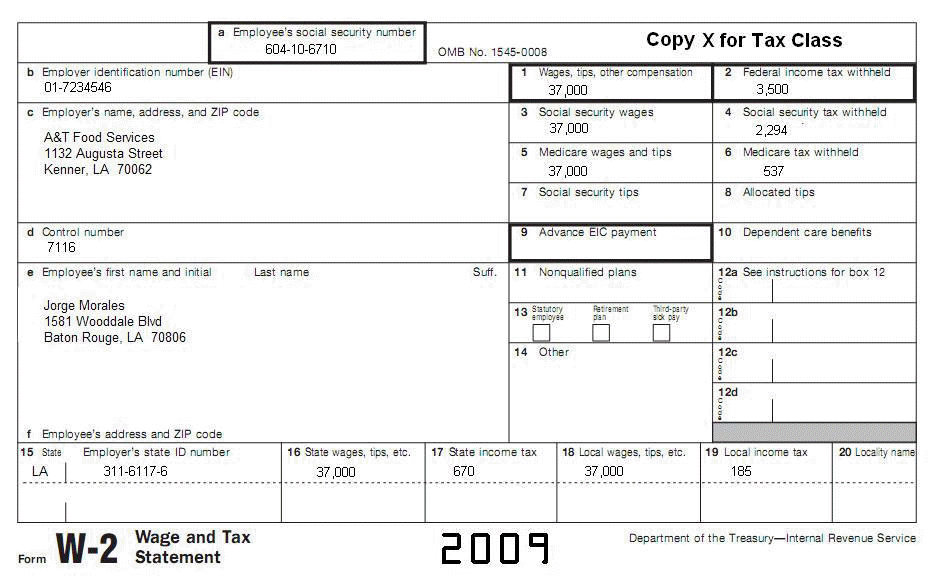
Complete a Form 2106, Schedule A, Form 1040 for Jorge Morales (SSN: 604-10-6710).

Jorge is getting a promotion. He will undergo training to become store manager. On behalf of his employer, he will attend training for 6 days for managerial training at the main restaurant. The company is paying for half of all his expenses. Jorge has to bring a statement of his expenses and his receipts to his employer. None of the expenses were included on line 1 of his W-2.

Jorge's employer reimbursement was $1,408 (including $375.00 for meals and entertainment).

 His expenses incurred are the following.

Plane ticket $650.00
Food cost $300.00
Hotel $955.00
Entertainment $450.00
Car Rental $460.00

Jorge is single and has no dependents. Get all their basic information from the following W2, including income information. All information is current.


1. Look at the Form 2106 you prepared for Jorge Morales. What is the amount on Form 2106, Line 9 column B?


A. $1,032.
B. $188.
C. $1,220. 
D. $0.

2. Look at the Form 2106 you prepared for Jorge Morales. What is the amount on Form 2106, Line 10?


A. $1,032.
B. $188.
C. $1,220. 
D. $0.

3. With regard to deductible travel expenses when attending a convention, all of the following statements are correct EXCEPT:

A. If you can show that your attendance benefits your trade or business,  you can deduct your travel expenses if the expenses are reasonable.
B. You cannot deduct expenses for attending a convention, seminar or similar meeting held outside of the North American area unless the meeting is directly related to your trade or business.
C. If you establish that a meeting held on a cruise ship is directly related to your trade or business, you may be able to deduct expenses of up to $2,000 per trip.
D. You must reduce otherwise deductible travel expenses that you pay by the reimbursements not reported on your Form W-2 that you receive from others for these expenses.

4. To meet the directly related test for entertainment expenses, you must show which of the following:

A. You did engage in business with the person during the entertainment period.
B. The main purpose of the combined business and entertainment was the active conduct of business.
C. You had more than a general expectation of receiving income or some other specific business benefit at some future time.
D. All of the above.

5. You are a self-employed caterer. To encourage the continuation of an existing business relationship, you took one of your clients to a Broadway show. The visit to the show occurred directly after a substantial business discussion with the client. You paid a ticket broker $300 for two tickets to that show. The face value of each ticket was $100 ($200 total). What is your total deductible expense for both tickets?

A. $100.
B. $150.
C. $200.
D. $300.


6. A businessman can deduct up to $2,000 per year of expenses for attending conventions, seminars, or similar meetings held on cruise ships. All of the following requirements must be met, except:

A. The convention, seminar, or meeting is directly related to your trade or business.
B. The cruise ship company provides a statement that it has adequate facilities to accommodate the needs of the convention, seminar, or meetings.
C. You attach a statement signed by you that includes information about (1) the total days of the trip; (2) the number of hours each day that you devoted to scheduled business activities; (3) A program of the scheduled business activities.
D. You attach to your return a written statement signed by an officer of the sponsoring organization or group that includes (1) A schedule of the business activities of each day of the meetings and (2) The number of hours you attended the scheduled business activities.

7. Horse and Carriage Partnership distributed the following gifts to their clients: 100 clipboards with their company logo on them, valued at $3 each ($300); 50 bottles of wine to clients who had orders over $50,000 in 2009 costing $35 each ($1,750) at Christmas. The amount that Horse and Carriage Partnership can deduct for business gifts in 2009 is:

A. $300.
B. $1,550.
C. $1,750.
D. $2,050.

8. Bart, a partner in the B&A Partnership attended the Comdex Computer Convention in Las Vegas. The partnership repairs and upgrades commercial computers for business use. At the convention, a new advanced computer hard drive was introduced that would make current machines run faster and more efficiently. Bart is responsible for purchasing hard drives for the computers used in the partnership. Bart's travel expenses excluding meals, were $950. Part of that amount includes a rental car of $100 incurred to visit his mother and $50 for flowers and candy he bought for her. How much is deductible as a business expense before any limitations?

A. $950.
B. $900.
C. $800.
D. $850.

9. You are considered to be traveling  away from home if


A. Your duties require you to be away from your general area of your tax home substantially longer than an ordinary day's work.
B. You need to sleep or rest to meet the demands of your work while away from home.
C. You are on a temporary assignment. 
D. All of the above except for C.

10. You are traveling away from your home if you need to sleep or rest to meet the demands of your work while away from home. The rest requirement can be satisfied by merely napping in your car. 

True False

11. You cannot deduct the costs of taking a bus, trolley, subway, or taxi, or driving a car between your home and your main or regular place of work

A. On a day off from your main job.
B. On a day you work for your main job.
C. On a day that you work your second job.
D. On any day.

12. You can deduct the cost of meals if

A. It is necessary for you to stop for substantial sleep or rest to properly perform your duties while traveling away from home on business.
B. The meal is business-related entertainment.
C. Meals do not take place in a luxury restaurant.
D. Both A and B above.

13. In deducting meals, the term "incidental expenses" means

A. Fees and tips given to porters, baggage carriers, bellhops, hotel maids, stewards and others on ships, and hotel servants in foreign countries.
B. Transportation between places of lodging or business and places where meals are taken, if suitable meals can be obtained at the temporary site.
C. Mailing costs associated with filing travel vouchers and payment of employer-separated charge card billings.
D. All of the above.

14. You can deduct all of your travel expenses if your trip was entirely business related. If your trip was primarily for business and, while at your business destination, you extended your stay for a vacation, made a personal side trip, or had other personal activities, you can deduct

A. Your business-related travel expenses.
B. Your cost of travel of getting to and from your business destination.
C. Any business-related expenses at your business destination.
D. Any of the above.

15. If your trip was for some business but primarily for personal reasons, such as a vacation, the entire cost of the trip is a nondeductible personal expense.

True False

16. Your trip is considered entirely for business if you did not have substantial control over arranging the trip. The fact that you control the timing of your trip does not, by itself, mean that you have substantial control over arranging your trip. You do not have substantial control over your trip if you


A. Are an employee who was reimbursed or paid a travel expenses allowance.
B. Are related to your employer.
C. Are a managing executive. 
D. All of the above.

17. If you travel outside the United States primarily for business but spend some of your time on other activities, you generally cannot deduct all of your travel expenses. You can only deduct the business portion of your cost of getting to and from your destination.

True False

18. Tomer, a travel agent, traveled by ocean liner from New York to London, England, on business in May. His expense for the 6-day cruise was $3,900. Tomer's deduction for the cruise is


A. $3,900.
B. $3,336.
C. $1,668.
D. $3,696.

19. You entertain a customer. The cost is an ordinary and necessary business expense and is allowed under the entertainment rules. The customer's spouse joins you because it is impractical to entertain the customer without the spouse. You


A. Can deduct the cost of entertaining the customer's spouse.
B. Can deduct the cost of entertaining your spouse when she joins the party because the customer's spouse is present.
C. Generally cannot deduct the cost of entertainment for your spouse or for the spouse of a customer. 
D. Both A and B above.

20. If you give a customer tickets to a theater performance or sporting event and you do not go with the customer to the performance or event, you


A. Can treat the tickets as either a gift expense or an entertainment expense, whichever is to your advantage.
B. Have to treat the tickets as a gift since you did not attend.
C. Have to treat the tickets as entertainment because tickets to a theater performance or sporting events are of an entertainment nature. 
D. None of the above.


Back to Tax School Homepage


Copyright © 2017 [Hera's Income Tax School]. All rights reserved.
Revised: 11/28/17