Sentry Password Protection Member Login

Student Login

Forgot? Show

Stay Logged In

My Profile

Javascript Required

Back to Tax School Homepage

Tax Topic 7 - Tax Deductions for Interest Expense


Interest is the amount you pay for the use of borrowed money. In this topic you will learn how to claim interest expenses on your tax return. The types of interest that you can deduct are home mortgage interest, and investment interest.

Student Instructions:

Print this page, work on the questions and then submit test by mailing the answer sheet or by completing quiz online.

Instructions to submit quiz online successfully: Step-by-Step check list

Answer Sheet            Quiz Online


Most forms are in Adobe Acrobat PDF format. Get Adobe ReaderYou will need Adobe Reader to view and print these forms. If you do not already have Adobe Reader installed on your computer, you may download the software for free.

 

Use IRS Publication 936, Publication 530 (mainly interest expenses but also other items) and Schedule A instructions to complete this topic.

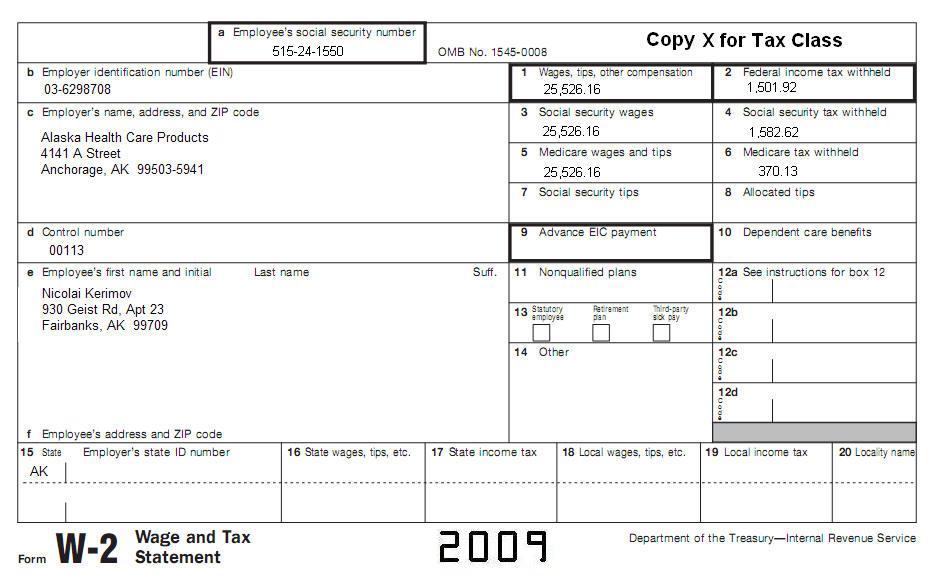
Complete a Schedule A for Nicolai Kerimov (Age 24, 515-24-1550).

Prepare a Federal Form 1040 for Nicolai. Get all basic information from the following W2, including income information.


He also has the following payments in 2009.

Home mortgage interest $9,622.00
County Property taxes $1,211.00
Car license tax (Includes only tax portion) $210.00
 

In addition to his earnings he had the following income:

Bank interest $290.00
Unemployment Compensation $545.00

Nicolai is not married and he has no children or other dependents.

Nicolai paid his mortgage interest for his home to:


Melvin R. Smitt
P.O. Box 70875
Eagle River, AK  99577
Social Security Number: 556-57-6811

Remember there is no 1098 issued and that mortgage interest was paid to an individual. 


1. Look at the Form 1040 you prepared for Nicolai. What is the amount on Form 1040, Line 40a?


A. $11,217.
B. $11,043.
C. $11,518. 
D. $11,128.

2. Look at the Form 1040 you prepared for Nicolai. What is the amount on Form 1040, Line 43?


A. $11,123.
B. $10,648.
C. $11,193.
D. $0.

3. If you do not meet the tests to fully deduct points in the year paid, the loan is not a home improvement loan, or you choose not to deduct your points in full in the year paid, you can deduct the points ratably over the life of the loan if

A. You use the cash method of accounting and your loan is secured by a home even if it is not your main home.
B. Your loan period is not more than 30 years, and if your loan period is more than 10 years, the terms of your loan are the same as other loans offered in your area for the same or longer period.
C. Either your loan amount is $250,000 or less, or the number of points is not more than 4, if your loan period is 15 year or less, or 6 points if your loan period is more than 15 years.
D. All of the above.

4. Generally, points you pay to refinance a mortgage are not deductible in full in the year you pay them. This is true,

A. Unless the new mortgage is secured by your main home.
B. Even if the new mortgage is secured by your main home.
C. Unless the new mortgage is secured by your second home.
D. Even if the new mortgage is secured by a second home.

5. Guillermo and Laura sold their home on May 7. Through April 30, they made home mortgage interest payments of $1,300. The settlement sheet for the sale of the home showed $80 interest for the 6-day period in May up to, but not including the date of sale. Their mortgage interest deduction is

A. $80.
B. $1,300.
C. $1,380.
D. None of the above.

6. If you sell your home, you can deduct your home mortgage interest (subject to any limits that apply),

A. Paid up to and including the date of sale.
B. Paid up to, but not including the date of sale.
C. Paid up to six months after the date of sale.
D. None of the above.

7. You can deduct all of the interest on mortgages you took out on or before October 14, 1987 (called grandfathered debt).

True False

8. If your adjusted gross income is more than $166,800 ($83,400 if you are married filing separately), the overall amount of your itemized deductions may be limited.                   

True False

9. As a general rule, Form 1098 will include only points that you can fully deduct in the year paid. Points not included on Form 1098

A. Also may be deductible.
B. Are never deductible.
C. Should not show any interest that was paid for you by a government agency.
D. None of the above.

10. You can treat amounts you paid during 2009 for qualified mortgage insurance as home mortgage interest. Qualified mortgage insurance is mortgage insurance provided by the

A. Department of Veteran Affairs.
B. Federal Housing Administration or the Rural Housing Service.
C. Private mortgage insurance as defined in section 2 of the Homeowner Protection Act of 1998 as in effect on December 20, 2006.
D. Any of the above.

11. You can treat amounts you paid during the 2009 year for qualified mortgage insurance as home mortgage interest. To do so,

A. The insurance must be in connection with home acquisition debt.
B. The insurance contract must have been issued after 2006.
C. The mortgage insurance contract must have been issued in 2008.
D. Both A and B above.

12. You cannot claim the credit for a home purchased after November 6, 2009, if

A. The purchase price of the home is $700,000.
B. You (and your spouse if married) are 18 on the date of purchase.
C. You can be claimed as a dependent on another person's tax return.
D. Any of the above.

13. You can exclude from gross income any discharges of qualified principal residence indebtedness made after 2006 and before 2013.

True False

14. Most state and local governments charge an annual tax on the value of real estate. You can deduct the tax if

A. It is based on the assessed value of the real property.
B. The taxing authority charges a uniform rate on all property in its jurisdiction.
C. The tax is for the welfare of the general public and not a payment for a special privilege granted or service rendered to you.
D. All of the above.

15. You can deduct as home mortgage interest a late payment as long as if was for a specific service in connection with your mortgage loan.

True False

16. If you make annual or periodic rental payments on a redeemable ground rent, you can deduct the payments as mortgage interest. The ground rent is a redeemable ground rent only if

A. Your lease, including renewal periods, is for more than 15 years and you can freely assign the lease.
B. You have a present or future right (under state or local law) to end the lease and buy the lessor's entire interest in the land by paying a specific amount.
C. The lessor's interest in the land is primarily a security interest to protect the rental payments to which he or she is entitled.
D. All of the above.

17. If you refinance the mortgage with the same lender, you

A. Cannot deduct any remaining points for the year.
B. You can deduct remaining points over the term of the new loan.
C. Both A and B above.
D. Can deduct the remaining points for the year.

18. If you receive a refund of mortgage interest you overpaid in a prior year, you generally will receive a Form 1098 showing the refund in box 3. Generally,

A. You must include the refund in income in the year you receive it.
B. You must file an amended 1040X return for the year you took the deduction in.
C. You must include it in income only if the amount decreased your tax paid in the year of deduction.
D. None of the above.

19. You may be eligible for a credit if you were issued a mortgage credit certificate (MCC) from your state or local government. Generally,

A. An MCC is issued only in connection with a new mortgage for the purchase of a brand new home.
B. An MCC is issued only in connection with a new mortgage for the purchase of your main home.
C. An MCC is issued in connection with a first time buyer program purchase.
D. An MCC is issued only if you have filled out a form 8396 and attached it to your return.

20. If your mortgage loan amount is equal to (or smaller than) the certified indebtedness amount shown on your MCC,

A. Enter all the interest you paid on your mortgage during the year.
B. Figure the credit on only part of the interest you paid.
C. Multiply the total interest you paid during the year on your mortgage by a fraction.
D. The fraction will not change as long as you are entitled to take the mortgage interest credit


Back to Tax School Homepage


Copyright © 2017 [Hera's Income Tax School]. All rights reserved.
Revised: 11/28/17