Sentry Password Protection Member Login

Student Login

Forgot? Show

Stay Logged In

My Profile

Javascript Required

Back to Tax School Homepage

Tax Topic 29 - Tax Withholding and Estimated Tax


Our federal income tax system is a pay-as-you-go tax. You must pay the tax as you receive the income during the year. In this tax topic you will learn how taxpayers get income withheld from their pay and other income such as pensions, bonuses, commissions, and gambling winnings. However, if no one withholds from your sources of income, you might have to pay estimated taxes such as when the taxpayer is business for himself or herself. A taxpayer may also have to pay estimated taxes on income such as dividends, interest, capital gains, rents, and royalties. In addition, you will learn how to take credit for the withholding on the tax return and calculate the penalties for not paying enough.  

Student Instructions:

Print this page, work on the questions and then submit test by mailing the answer sheet or by completing quiz online.

Instructions to submit quiz online successfully: Step-by-Step check list

Answer Sheet            Quiz Online

Most forms are in Adobe Acrobat PDF format. Get Adobe ReaderYou will need Adobe Reader to view and print these forms. If you do not already have Adobe Reader installed on your computer, you may download the software for free.


Material needed to complete this assignment:

Please use IRS Publication 505 and IRS Publication 515 to complete this topic. You may also need instructions for Form 1040.

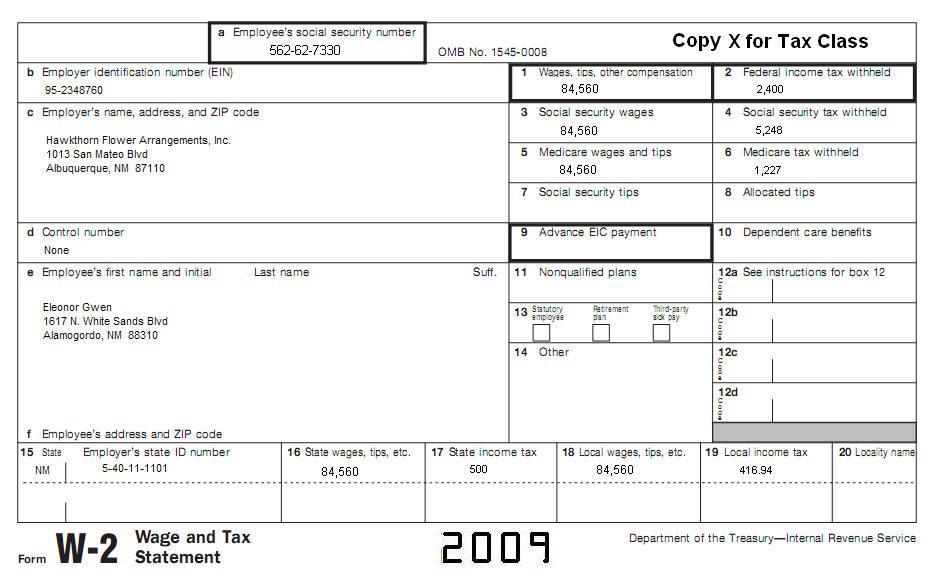
Prepare Form 1040 and Form 2210 (if needed) for Eleonor Gwen. She is single and has no dependents.

In tax year 2008 Eleonor did not have a tax liability. However, for 2009, Eleonor worries that she may owe a penalty for underpayment of her tax.


1. Look at the Form 1040 you prepared for Eleonor Gwen. What is the amount on Form 1040, Line 75?


A. $12,594.
B. $15,380.
C. $2,400. 
D. $12,850.

2. Look at the Form 1040 you prepared for Eleonor Gwen. What is the amount on Form 1040, Line 76?


A. $1,980.
B. $0.
C. $240. 
D. $1,538.

3. You must make estimated tax payments for 2010 if you expect to owe at least $1,000 in tax year 2010, after subtracting your withholding and credits, and you expect your withholding and credits to be less than the smaller of: (1) 90% of the tax to be shown on your 2010 tax return, or (2) 100% of the tax shown on your 2009 tax return. Your 2009 tax return must cover all 12 months.

True False

4. If you had income tax withheld during 2009, you should receive a statement by February 2, 2010, showing your income and the tax withheld. Depending on the source of your income, you will receive:

A. Form W-2, Wages and Tax Statement.
B. Form W-2G, Certain Gambling Winnings.
C. A form in the 1099 series.
D. Any of the above.

5. Sue must make estimated tax payments of $4,000 for tax year 2010. She makes the following payments:

    1st payment - $1,000 on April 20, 2009.

    2nd payment - $1,000 on May 31, 2009.

    3rd payment - $1,000 on September 1, 2009.

    4th payment - $1,000 January 10, 2010.   

A. She has not made timely payments because her 1st payment was not made by April 15th.
B. She has not made timely payments because her 2nd payment was not made by June 15th.
C. She has made timely estimated payments.
D. She has not made any timely payments because none of the payments were made by the required IRS schedule.

6. Income tax is withheld at a flat rate from certain kinds of gambling winnings. Gambling winnings from any sweepstakes, wagering pool, or lottery, or any other wager if the proceeds are at least 300 times the amount of the bet, are subject to income tax withholding if the winning are more than

A. $3,050.
B. $5,000.
C. $600.
D. $1,500.

7. Marge Goodfrey sold her investment property March 30, 2009 at a gain of $50,000. Marge expects to owe $10,000 in additional income taxes on this sale. She had a tax liability of $900 for 2008 and will have no withholding for 2009. Marge's first estimated tax payment is due on what date?

A. April 30, 2009.
B. April 15, 2009.
C. January 31, 2010.
D. June 15, 2009.

8. The tips you receive while working on your job are considered to be part of your pay. Your employer will take into account the tips you report when figuring how much to withhold from your regular pay. You employer can figure your withholding by

A. Withholding at the regular rate on the sum of your pay plus your reported tips.
B. Withholding at the regular rate on your pay plus a percentage of your reported tips.
C. Withholding as much social security tax, Medicare tax, or railroad retirement tax as possible.
D. Both A and B above.

9. Susan, a single filer, started a home-based dress business on March 1, 2009. She was an employee and paid income taxes of $6,000 for 2008. Susan's business had net income of $0, $9,000, $11,000, and $15,000 respectively for each of the calendar quarters in 2009. Susan's total tax liability for the year was $5,500. Her first payment of estimated taxes is due:

A. April 15.
B. No estimates are due if Susan files by January 31, 2010.
C. June 15.
D. Susan's tax liability for 2008 exceeds 90% of her 2009 tax liability so no estimated payments are required to be paid.

10. If you have been notified by a payer that the TIN you gave is incorrect, you can usually prevent backup withholding from starting or stop backup withholding once it has begun by giving the payer your correct name and TIN. You must certify the TIN you give is correct. However, the payer will provide additional instructions if the TIN you gave needs to be validated by the Social Security Administration or by the IRS, if

A. The IRS notifies the payer twice within 3 calendar years that a TIN you gave fro the same account is incorrect.
B. The incorrect TIN is still being used on the account when the payer receives the second notice.
C. Both A and B above.
D. None of the above.

11. Generally, you are considered to have reason to know that a claim to U.S. status or of a reduced rate of withholding is incorrect if statements contained in the withholding certificate or other documentation or other relevant facts of which you have knowledge,  

A. Would cause a reasonably prudent person in your position to question the claims made.
B. Cannot base your determination on the receipt of statements or documents.
C. Have a mailing or residence address outside the treaty country.
D. Any of the above.

12. You may be liable for tax, interest, and penalties if you

A. Comply with the presumption rules even if the rate of withholding that should have been applied based on actual status of payee is different than presumed.
B. If you rely on your actual knowledge about a payee's status and withhold an amount less than that required under the presumption rules.
C. Report a payment that is subject to reporting under the presumption rules.
D. Any of the above.

13. A payment is subject to NRA withholding if it is from sources within the United States, and it is a fixed or determinable annual or periodical (FDAP) income or 

A. Are certain gains from the disposition of timber, coal, and iron ore.
B. Are from the sale or exchange of patents, copyrights, and similar intangible property.
C. Either A or B above.
D. Are insurance premiums paid on a contract issued by a foreign insurer.

14. The following items are examples of FDAP income, except

A. Compensation for personal services.
B. Real property income, such as rents.
C. Market discount and option premiums.
D. A commission paid for a single transaction.

15. Generally, when a foreign person engages in a trade or business in the United States, all income from sources in the United States connected with the conduct of that trade or business is considered effectively connected with a U.S. business. A factor to consider in establishing whether FDAP income is effectively connected with a U.S. trade or business is 

A. Whether the income is from assets used in, or held for use is, the conduct of that trade or business.
B. Whether the activities of that trade or business were a material factor in the realization of the income.
C. Either A or B above.
D. Whether the services were performed by an individual or an entity.

16. Illegal aliens who are resident aliens and who receive income from performing dependent personal services are

A. Subject to 30% withholding.
B. Subject to the same reporting and withholding obligations which apply to U.S. citizens for the same kind of income.
C. Are not subject to U.S. taxes because of their illegal status.
D. Are not subject to U.S. taxes since they are nonresident aliens.

17. Compensation paid to certain residents of Canada or Mexico who enter or leave the United States at frequent intervals are not subject to withholding. To qualify for the exemption from withholding during the year, a Canadian or Mexican resident must give the employer a statement with name, address, and identification number, and certifying that 

A. He or she is not a U.S. citizen or resident.
B. He or she is a resident of Canada or Mexico.
C. He or she expects to perform the described duties during the tax year.
D. All of the above.

18. Every withholding agent, whether U.S. or foreign, must file _________ to report payments to amounts subject to NRA withholding. 

A. Form 1042 and Form 1042-S.
B. Form 1040ES.
C. Form 8288 and Form 8288-A.
D. Form 8804-W.

19. A partner that is a U.S. person should provide Form W-9 to the partnership. A partnership may rely on a partner's certification of nonforeign status and assume that a partner is not a foreign partner unless 

A. The form does not give the partner's name, U.S. taxpayer identification number and address.
B. The form is not signed under penalties of perjury and dated.
C. The partnership has reason to know that any information on the form is incorrect or unreliable.
D. Any of the above.

20. The general rule exceptions apply for farmers and fishermen. If at least two-thirds of your gross income for 2009 or 2010 is from farming or fishing, your required annual estimated payment is

A. 90% of your total expected tax for 2010.
B. 66 2/3 % (.6667) of your total tax for 2010.
C. 100% of the total tax shown on your 2009 tax return that must cover all 12 months of the year.
D. Is the smaller of B and C above.


Back to Tax School Homepage


Copyright © 2017 [Hera's Income Tax School]. All rights reserved.
Revised: 11/28/17