Sentry Password Protection Member Login

Student Login

Forgot? Show

Stay Logged In

My Profile

Javascript Required

Back to Tax School Homepage

Tax Topic 28 - Divorced or Separated Individuals


In this tax topic you will learn the tax rules that apply to divorced or separated individuals. In this topic you will also cover general filing information and even more information on filing status and exemptions you are entitled to claim when you are divorced or separated. In addition, you will learn about payments and transfers of property that occur as a result of divorce such as alimony and how you must report them on the tax return. Finally, your will become familiar with the deductions allowed for some of the costs of obtaining a divorce.

Student Instructions:

Print this page, work on the questions and then submit test by mailing the answer sheet or by completing quiz online.

Instructions to submit quiz online successfully: Step-by-Step check list

Answer Sheet            Quiz Online

Most forms are in Adobe Acrobat PDF format. Get Adobe ReaderYou will need Adobe Reader to view and print these forms. If you do not already have Adobe Reader installed on your computer, you may download the software for free.


Material needed to complete the sections in this assignment:

Use IRS Publication 504, IRS Publication 555 and IRS Publication 971 to complete this topic.

Prepare a  Form 1040.

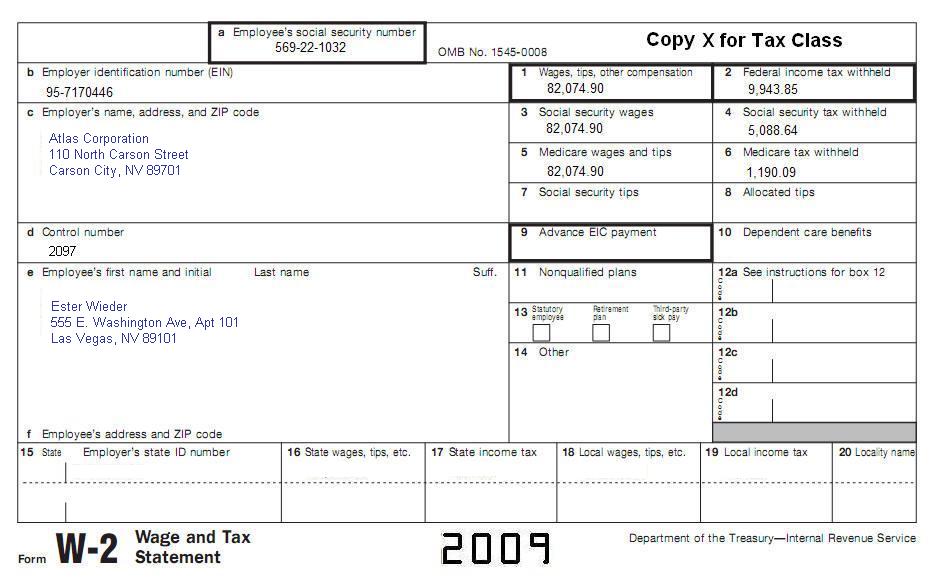
Esther must pay her former husband $20,000 in cash each year for 10 years. The death of her former spouse would not terminate these payments under state law. Esther's former spouse's name is Frank Eiffel (SSN 463-34-3426).

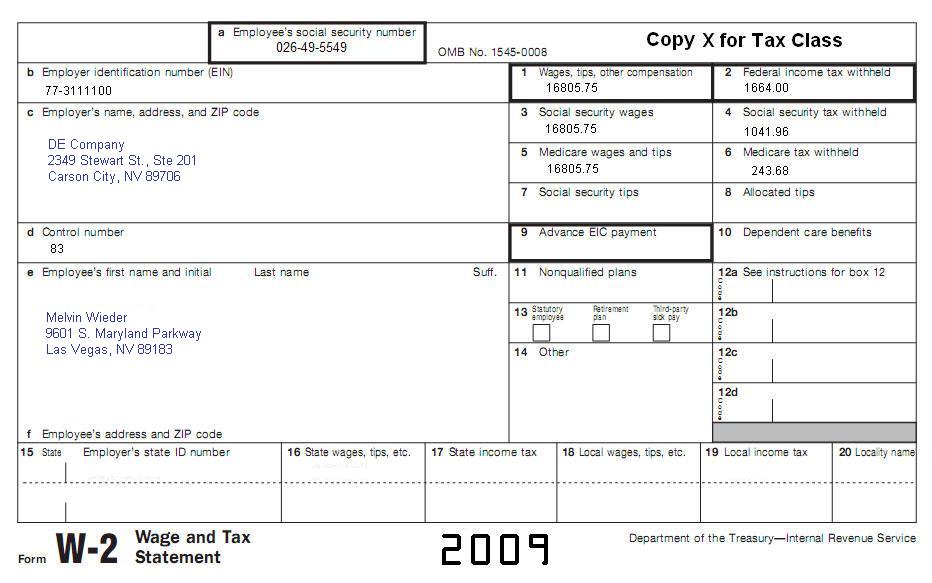
Esther does not have any children. Esther has remarried. Her new husband's name is Melvin Weider. For 2009, Melvin received $6,000 in court ordered alimony payments. They lived in the same household all year. She is currently having marital problems and her husband does not want to file jointly with Esther. Esther happens to have copies of her husbands W-2. She has tried to convince him to file jointly with her, but has had no success. There is no other income for either one.

Use the following information and Form W-2 to complete return. There is no other information.


1. Look at the Form 1040 you prepared for Esther Wieder. What is the amount on Form 1040, Line 22?


A. $82,075.
B. $49,440.
C. $62,075.
D. $52,440.

2. Look at the Form 1040 you prepared for Esther Wieder. What is the amount owed or refunded?


A. $2,988 refund.
B. $402 owed.
C. $7,350 refund.
D. $3,210 refund.

3. Todd and Susan divorced on September 1, 2008. As part of the divorce decree, beginning in September, Todd was to make payments of $2,000 per month for the balance of the year to Susan's doctor for recent medical expenses; child support payments of $500 per month, and $1,500 a month for the mortgage payment on a jointly owned home. Susan and the children continue to live in the home. What is the amount that Todd can deduct as alimony for 2008?

A. $8,000.
B. $11,000.
C. $4,200.
D. $9,600.

4. Which of the following items may be considered alimony?

A. Noncash property settlement.
B. Payments you made under a written separation agreement for the mortgage and real estate taxes on a home you owned by yourself and in which your former spouse lived rent-free.
C. Payments made to a third party on behalf of the former spouse for the former spouse's medical expenses.
D. Payments that are your spouse's part of community income.

5. Alimony is a payment to or for a spouse or former spouse under a divorce or separation instrument. It does not include

A. Voluntary payments that are not made under a divorce or separation instrument.
B. Payments for your spouse's medical expenses.
C. Payments for your spouse's housing costs (rent, utilities, etc.), taxes, tuition.
D. Premiums you must pay under your divorce or separation instrument for insurance on your life to the extent your spouse owns the policy.

6. If you are requesting innocent spouse relief, separation of liability relief, or equitable relief, file Form 8857,

A. Two years after the date on which the IRS first began collection activities against you.
B. Two years after the date your first filed your return for which you are seeking relief.
C. No later than two years after the date on which the IRS first began collection activities against you.
D. At any time 10 years after you filed your return in question since the IRS has 10 years to collect an amount you owe.

7. A property transfer is incident to your divorce if the transfer occurs within one year after the date your marriage ends, or is related to the ending of your marriage. If the property transfer is made under your original or modified divorce or separation instrument and the transfer occurs within 6 years after the date your marriage ends, then the property transfer is

A. Is not alimony.
B. Related to the ending of marriage.
C. Not related to the ending of marriage.
D. None of the above.

8. If you must pay all the mortgage payments (principal and interest) on a jointly-owned home, and they otherwise qualify, you

A. Cannot deduct any of the payments as alimony.
B. Can deduct one-half of the total payments as alimony.
C. You can deduct one-half of the total payments as child support.
D. None of the above.

9. If you must pay all the real estate taxes or insurance on a home held as tenants in common, you

A. Can deduct one-half of these payments as alimony.
B. Cannot deduct any of the payments as alimony.
C. You can tell your spouse that she does not need to report her half of these payments as alimony received.
D. None of the above.

10. Not all payments under a divorce or separation instrument are alimony. Alimony does not include

A. Child support.
B. Noncash property settlements.
C. Payments that are your spouse's part of community income.
D. Any of the above.

11. A payment to or for a spouse under a divorce or separation instrument is alimony if the spouses do not file a joint return with each other. Which of the following is not one of the requirements that must be met.

A. The payment is in cash.
B. The instrument does not designate the payment as not alimony.
C. The spouses are not members of the same household at the time the payments are made only if they are legally separated under a decree of divorce or separate maintenance.
D. Must hold a valid divorce decree.

12. If you are not legally separated under a decree of divorce or separate maintenance, a payment under a written separation agreement, support decree, or other court order

A. Does not qualify as alimony if you are members of the same household when the payments are made.
B. May qualify as alimony even if you are members of the same household when the payments are made.
C. Qualifies as alimony if spouse includes it in income.
D. None of the above.

13. If the transfer of property between former spouses is because of divorce, there is

A. No recognized gain or loss on the transfer of property between spouses.
B. There is recognized gain and it is considered alimony.
C. A gain if the transfer was in exchange for cash.
D. A gain if the transfer was in exchange for assumption of liability.

14. You and your spouse can designate that otherwise qualifying payments are not alimony. You do this by including a provision in your divorce or separation instrument that states that payments are not deductible as alimony by you and are excludable from your spouse's income. Your spouse can exclude the payments from income only if

A. He or she faxes a copy to the IRS and writes "Attention IRS district director" and tell him to designate the payments.
B. He or she calls the IRS to let them know that alimony does not need to be included.
C. He or she attaches a copy of the instrument designating the payments as not alimony to his or her return.
D. He or she does not do anything because as long as a credit is not taken then income does not need to be included.

15. A payment that is specifically designated as child support or treated as specifically designated as child support under your divorce or separation instrument in not alimony. The designated amount or part may vary from time to time. Child support payments are

A. Taxable to the recipient.
B. Neither deductible by the payer nor taxable to the payee.
C. Deductible by the payer.
D. None of the above.

16. You must pay your former spouse $15,000 in cash each year for 10 years. The death of your spouse would not terminate these payments under state law. The $15,000 annual payments

A. Are alimony.
B. Are not alimony because the payments will not end upon former spouse's death.
C. Are alimony because they end at spouse's death.
D. None of the above.

17.  A contingency relates to your child if it depends on any event relating to that child. An event relating to your child is

A. A child becoming employed.
B. A child dying.
C. A child marrying.
D. Any of the above.

18. Your payments may be subject to the recapture rules if they

A. Decrease by more than $15,000 from the second year during the first three calendar years.
B. Decrease significantly in the 2nd or 3rd years from the alimony.
C. Decrease or terminate during the first five calendar years.
D. Either A or B above.

19. A payment will be treated as specifically designed as child support to the extent that the payment is reduced

A. On the happening of a contingency relating to your child.
B. At the time that can be clearly associated with the contingency.
C. Either A or B above.
D. None of the above.

20. The reason for a reduction or termination of alimony payments that can require a recapture is

A. A change in your divorce or separation instrument.
B. A failure to make timely payments.
C. A reduction in your ability to provide support or a reduction in your spouse's support needs.
D. Any of the above


Back to Tax School Homepage


Copyright © 2017 [Hera's Income Tax School]. All rights reserved.
Revised: 11/28/17