
Tax Topic 14 - Tax Provisions for the Elderly and the Disabled


In this tax topic you will learn how you may be able to reduce the tax owed by taking the credit for the elderly or the the disabled. Additionally, you will learn who qualifies to take the credit for the elderly and and how to figure the credit. Individuals who are able to take the credit for the elderly or the disabled are usually individuals who are are age 65 or older, or are individuals who are retired on permanent and total disability and have taxable disability income.

Tax School Homepage

Student Instructions:

  1. Read the reading material and answer the questions on this page.

  2. Submit the answers to the Assignment online (the questions on this page).

  3. Complete a short quiz on the reading material: Short Quiz online. You have 30 minutes to complete 20 questions for this quiz. You must study the reading material. You won't have time to look up questions in the reading material.

So just to recap: for every section or topic you will submit an assignment (step 2) and a short quiz (step 3). Once these two items are submitted, a certificate will be issued to you.

Important: If you fail a topic you can try again until you pass. However, you cannot try again until 24 hours later. This will give you enough time to study and review the reading material. If you don't pass, you can retry - Every time you try the questions will be different. If you try again without giving it the required 24 hour wait period, you will be disqualified from completing this topic.

Most forms are in Adobe Acrobat PDF format. Get Adobe ReaderYou will need Adobe Reader to view and print these forms. If you do not already have Adobe Reader installed on your computer, you may download the software for free.

 

Use IRS Publication 524 and IRS Publication 554 (also IRS 1040A Instructions) to complete this topic. 

Prepare a Federal Form 1040A and Schedule R for Henry Watts.  Get all basic information from W2, including income information.

Address information on W2 is current.

Mr. Watson's date of birth is April 6, 1942.
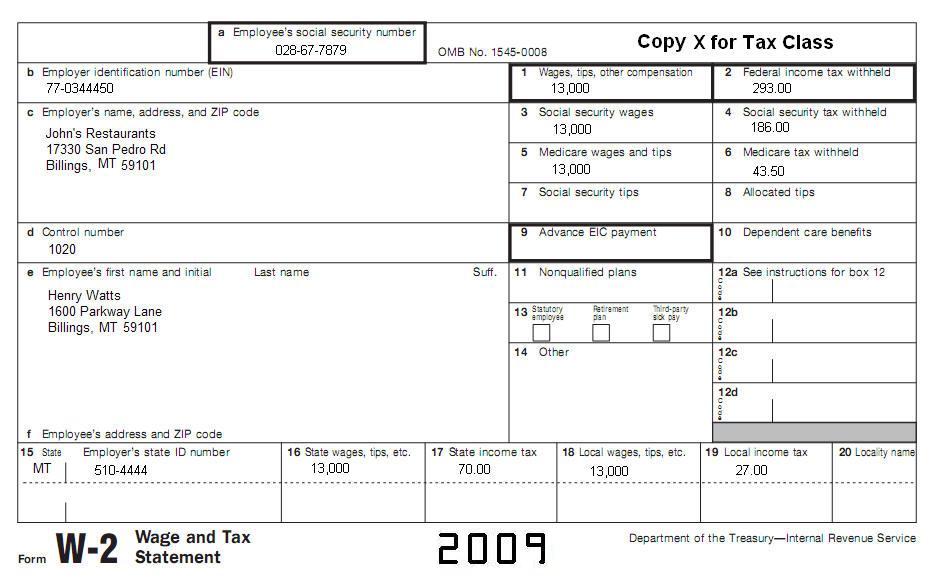
 

1. Look at the Form 1040A you prepared for Henry Watts. What is the amount on Form 1040A, Line 30?

A. $408.
B. $338.
C. $70. 
D. $0.

2. Look at the Form 1040A you prepared for John Watson. What is the amount on Form 1040A, Line 37?

A. $293.
B. $223.
C. $70. 
D. $0.

3. If you were under age 65, to be a qualified individual for the credit for the elderly and the disabled you must have

A. Retired on permanent and total disability.
B. Received taxable disability income for tax year 2009.
C. Not have reached mandatory retirement age on January 1, 2009. 
D. All of the above.

4. If you and your spouse did not live in the same household at any time during the tax year, you are still able to take the credit for the elderly and the disabled and

A. You do not need to file a return.
B. You can file either joint or separate return.
C. You must file a joint return.
D. You must each file as single.

5. You can file as head of household and qualify to take the credit for the elderly and the disabled even if your spouse lived with you during the first 6 months of the year. Which of the following is not one of the tests that you need to meet?

A. You file a separate return.
B. You paid more than half the cost of keeping up your home during the tax year.
C. Your home was the main home of your child, stepchild, or eligible foster child for more than half the year.
D. Your child must pass the gross income test.

6. If you are under the age of 65, you can qualify for the credit for the elderly only if you are retired on permanent and total disability. You are retired on permanent and total disability if

A. You were permanently and totally disabled when you retired.
B. You retired on disability before the close of the tax year.
C. You have stopped working because of your disability.
D. All of the above.

7.  You are permanently and totally disabled if you

A. Cannot engage in any substantial and gainful activity because of your physical or mental condition.
B. Cannot sit or stand for a long period of time.
C. Cannot take care of your children because babysitting fatigues you.
D. None of the above.

8.  Alicia, a sales clerk, retired on disability. She is 57 years old and now works as a full-time babysitter for the minimum wage. Alicia

A. Cannot take the credit because she is able to engage in substantial and gainful activity.
B. Can take the credit because babysitting is not considered a real job and it is not a substantial and gainful activity.
C. Can take the credit because the minimum wage is not a substantial wage.
D. Can claim the credit because it does not matter that she works or not as long as she has retired on disability.

9. Certain work offered at qualified locations to physically or mentally impaired persons is considered sheltered employment. If a person that retires on disability accepted sheltered employment, this employment

A. Disqualifies him/her from any further disability benefits.
B. Disqualifies him/her from getting the credit for the elderly and the disabled.
C. Is proof of the person's ability to engage in substantial and gainful activity.
D. Is not proof of the persons ability to engage in substantial and gainful activity.

10. If you are under the age of 65, you must have a completed statement certifying that you were permanently and totally disabled on the date you retired. This statement must be completed and signed by

A. Your neighbor who knows you very well.
B. Your co-workers at the company you last worked for.
C. Your physician.
D. Your leader from your congregation who would not lie.

11. You should file a return to get a refund even if you are not otherwise required to file a return, if

A. Income was withheld from your pay.
B. You qualify for the earned income credit.
C. You qualify for the first-time homebuyer credit.
D. Any of the above
.

12. If you are the owner of a traditional IRA, you must receive the entire balance in your IRA or start receiving periodic distributions from your IRA by April 1 of the year following the year in which you reach age

A. 70 1/2.
B. 65.
C. 55.
D. 45.

13. Before you can figure how much, if any, of your pension or annuity benefits are taxable, you

A. Must subtract any premiums.   
B. Must determine your cost in the plan.
C. Must determine your expenses.
D. Must determine all of the above.

14. To make sure that most of your retirement benefits are paid to you during your lifetime, rather than to your beneficiaries after your death, the payments that your receive from qualified retirement plans must begin no later than your required beginning date. Unless the rule for 5% owners applies, this is generally April 1 of the year that follows

A. The calendar year in which your reach age 70%.   
B. The calendar year in which you retire from employment with the employer maintaining the plan. 
C. The later of A and B above.
D. The earlier of A or B above.

15. The early distribution tax does not apply to any distributions that are

A. Made as part of a series of substantially equal periodic payments (made as least annually) for your life (or life expectancy) or the joint lives (or joint life expectancies) of you and your designated beneficiary.  
B. Made because you are totally and permanently disabled. 
C. Made on or after the death of the plan participant or contract holder. 
D. Any of the above.

16. If the only income you received during 2009 was your social security or the SSEB portion of tier 1 railroad retirement benefits, your benefits generally are not taxable and your probably do not have to file a return.

True False

17. Generally, you must report as income any amount you receive for personal injury or sickness through an accident or health plan that is paid for by your employee. If both you and your employer pay for the plan,

A. Only the amount you receive that is due to your employer's payments is reported as income.
B. Only the amount you receive that is due to your payments is reported as income. 
C. Only the amount your receive that was not paid by your employer and your is reported as income. 
D. None of the above.

18. If you pay the entire cost of an accident or health plan, include amounts your receive from the plan for personal injury or sickness as income on your tax return.

True False

19. Do not report the 2009 sale of your main home on your tax return unless

A. You have a gain and you do not qualify to exclude all of it.
B. You have a gain and you choose not to exclude it.
C. Either A or B above.
D. You have a gain and you qualify to exclude all of it.

20. Your standard deduction is zero and you should itemize any deductions if

A. You are married and filing a separate return, and your spouse itemizes deductions.
B. You are filing a tax return for a short tax year because of a change in your annual accounting period.
C. You are a nonresident or dual-status alien during the year.   
D. All of the above.

Copyright © 2010 [Hera's Income Tax School]. All rights reserved.
Revised: 05/14/12