Tax Workshop 1 - Filing Information  

This is your first workshop in the basic certification tax preparation course. This tax workshop will help you figure whether or not you have to file a return, which form to use. In addition, you will find out when, how and where to file and what happens if you pay too little or too much tax. Furthermore, you know how you can change a return you have already filed and what records you must keep. 

Tax School Homepage

Student Instructions:

  1. Read the reading material and answer the questions on this page.

  2. Submit the answers to the Assignment online.

  3. Complete a short quiz on the reading material: Short Quiz online. You have 40 minutes to complete this quiz. You must study the reading material. You won't have time to look up questions in the reading material. If you don't pass, you can retry - Every time you try the questions will be different.


Most forms are in Adobe Acrobat PDF format. Get Adobe ReaderYou will need Adobe Reader to view and print these forms. If you do not already have Adobe Reader installed on your computer, you may download the software for free.


 

Material needed to complete this assignment:

bullet

IRS Publication 17 to complete Workshop 1 assignment in step 2 and to study for the online tax quiz in step 3 above.

bullet

Form 1040-EZ to complete the tax return.


Use IRS Publication 17 Chapter 1, including the information from page 1 to page 6 and tax table at end of Publication 17, to respond to the following questions and to complete this workshop.

Prepare a Federal Form 1040-EZ  return for Sol Baird.  Get all her basic information from the following W2, including income information. Sol did not received an economic recovery payment in 2009.
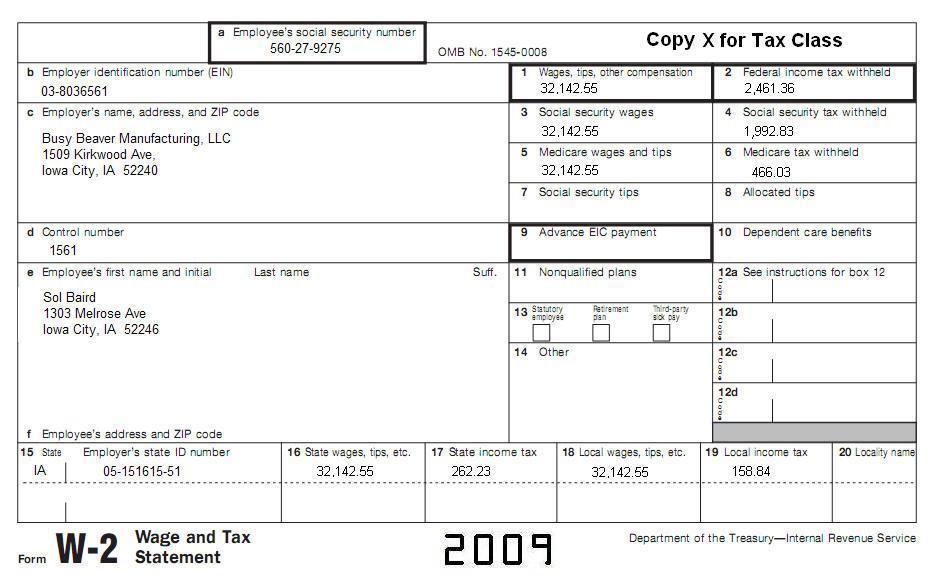


1. Look at the Form 1040EZ you prepared for Sol Baird. What is the amount on Form 1040EZ, Line 11?

A. $2,999.
B. $2,581.
C. $2,861. 
D. $0.

2. Look at the Form 1040EZ you prepared for Sol Baird. What is the amount on Form 1040EZ, Line 13?

A. $538.
B. $138.
C. $2,461. 
D. $0.

3. Kathy, a U.S. citizen, is 22 and correctly files as single. In 2009, she had net self-employment income of $550 after expenses. She had no other income or any tax payments. She does not have to file a federal income tax return for the tax year 2009.

True False

4. Which of the following statements is true regarding the filing of a Form 4868, Application for an Automatic Extension of Time to File, your 2009 tax return?

A. Interest is not accessed on any income tax due if a Form 4868 is filed.
B. Form 4868 provides the taxpayer with an automatic 4 months extension to file.
C. Even though you file Form 4868, you will owe interest and may be charged a late payment penalty on the amount you owe if you do not pay the tax due by the regular due date.  
D. A U.S. citizen, who is out of the country on April 15, will be allowed an additional 12 months to file as long as "Out of the country" is written across the top of Form 4868.

5. Maria is age 18 and single. Her only income in 2009 was $600 of self employment income from selling cosmetics. Maria is not required to file for tax year 2009.

True False

6. To obtain an automatic extension of time to file an individual tax return for tax year 2009, Form 4868, Application for Automatic Extension of time to file U.S. Individual Income Tax Return, must be filed by March 15, 2010.

True False

7. Ms. Garcia owns an apartment complex. She received $5,000 in December 2009 to cover the January rents for tenants who will be on vacation January 15, 2010, when the rent is due. Although she is a cash basis taxpayer for purposes of filing her return, she uses the accrual method of accounting to maintain her books on the rental property. Since she uses the the accrual method of accounting, she should report the $5,000 in 2010.

True False

8. Interest was credited to Jane's savings account on December 31, 2009. As long as Jane leaves the interest in the account and does not withdraw it, the interest in NOT taxable to her.

True False

9. Generally, if an unmarried dependent child, John, earns $4,200 in wages during the summer, has no tips, has $200 in interest/dividends, and no income tax withheld, he would not be required to file a tax return for 2009.

True False

10. Rebecca, age 88, and Charles, age 90, are married, live together, and file jointly. During 2009, they received interest income of $3,000, dividend income of $1,500, a pension of $10,000 and Social Security of $17,000. Rebecca and Charles are NOT required to file a tax return.

True False

11. You can claim the child-care credit on Form 1040EZ.

True False

12. Which of the following would be considered a fiscal tax year?

A. 02/15/08 - 03/15/09.
B. 08/01/08 - 07/31/09.
C. 04/01/08 - 04/30/09.
D. 01/01/09 - 12/31/09.

13. In which of the following situations is NO return required to be filed for 2009?

A. Single, filing status single, under age 65, gross income $10,000.
B. Married, joint filing status, both spouses under age 65, gross income $13,000.
C. Single, filing status single, age 70, gross income $8,000.
D. Married, Separate filing status, age 65, gross income $5,000.

14. Which of the following statements regarding extensions of time to file is correct?

A. An automatic 2-month extension can be obtained by filing Form 4868, Application for Automatic Extension of Time to File U.S. Individual Income Tax Return.
B. An additional automatic 6-month extension can be obtained by filing Form 2688, Application for additional Extension of Time to File U.S. Individual Income Tax Return.
C. A penalty for late payment may still be charged even if an extension is granted.
D. A extension request for a 2009 individual income tax return must be filed by August 15, 2010.

15. If your spouse if a nonresident alien, your spouse must have either an SSN or an ITIN if

A. You file a joint return.
B. You file a separate return and claim an exemption for your spouse.
C. Your spouse is filing separate return.
D. Any of the above.

16. If you choose direct deposit of your refund, you

A. May be able to split the refund into two or three accounts.
B. May be able to deposit the refund in the account of any member of your family.
C. Have to have your funds deposited in only one account.
D. Have to wait three months to receive your refund in your bank account.

17. If you were due a refund but did not file a return, you generally must

A. File your return within 3 years from the date the return was due (excluding extensions) to get that refund.
B. File your return within 3 years from the date the return was due (including extensions) to get that refund.
C. File your return before the end of the year to get that refund.
D. File your return before April 15, of the following year to get that refund.

18. Beginning in 2010, the modified AGI and filing status requirements for conversions to Roth IRAs are eliminated. For any conversions in 2010, any amounts that would be included as income

A. Will be included in income in equal amounts in 2011 and 2012.
B. The entire amount can be included in income in 2010.
C. Both A and B above.
D. Will not be included in income in any tax year.

19. The following benefits are to be available for 2010:

A. Deduction for educator expenses in figuring AGI.
B. Itemized deduction or increased standard deduction for state or local sales or excise taxes on the purchase of a new motor vehicle.
C. Government retiree credit.
D. None of the above.

20. If you are a U.S. citizen or resident, whether you must file a return depends on

A. Your gross income.
B. Your filing status.
C. Your age.
D. All of the above.

Copyright © 2010 [Hera's Income Tax School]. All rights reserved.
Revised: 05/14/12