
Tax Topic 5 - Standard Deduction VS Itemized Tax Deductions

The standard deduction for most taxpayers who do not itemize their deductions is usually higher every year. The standard deduction annual increase is usually due to inflation adjustments. Every tax year, you either have to use the standard deduction that is provided to you depending on your filing status and certain other situations. Itemizing your deductions on the other hand is based on any state or real estate taxes, medical and dental expenses, home mortgage interest and job expenses. You have a choice on which of the two deductions to use, standard or itemized. However, you would normally choose the higher amount because it will give your the greater benefit.

Tax School Homepage

Student Instructions:

  1. Read the reading material and answer the questions on this page.

  2. Submit the answers to the Assignment online.

  3. Complete a short quiz on the reading material: Short Quiz online. You have 40 minutes to complete this quiz. You must study the reading material. You won't have time to look up questions in the reading material. If you don't pass, you can retry - Every time you try the questions will be different.

 
Most forms are in Adobe Acrobat PDF format. Get Adobe ReaderYou will need Adobe Reader to view and print these forms. If you do not already have Adobe Reader installed on your computer, you may download the software for free.

 

Use IRS Publication 501, Schedule A (1040) instructions and Schedule L (Form 1040) to complete this tax topic.

Prepare a Federal Form 1040  return for Rodolfo Ramirez. Fill out a  Schedule A (Form 1040) with all the following deductible expenses to complete the return.
bulletMedical Expenses $3,500
bulletReal estate taxes $950
bulletOther taxes (DMV tax, tax part only) $500
bulletHome Mortgage Interest $9,860
bulletUnion dues $700
bulletTax Preparation fee $207

Rodolfo purchased a new motor vehicle on March 15, 2009, for $56,500 before taxes. He paid 6% sales tax on the purchase.

Rodolfo contributed 12% of his wages to his religious organization: Downtown Church, 5647 Santee Court, Alpharetta, GA  30004.

Get all their basic information from the following W2, including income information. 
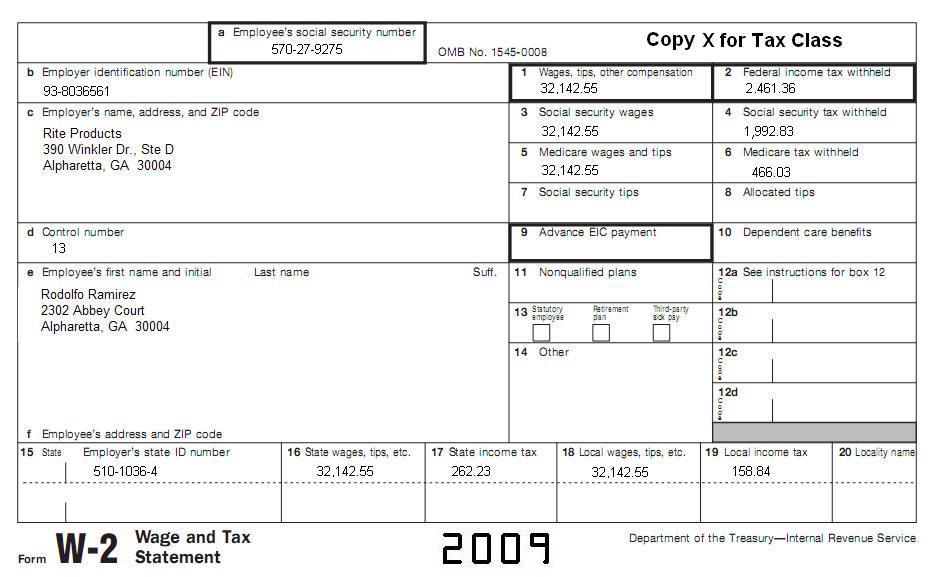


Rodolfo is married and his wife is Anna Ramirez (Anna's SSN 505-57-9464). Have their return prepared and ready to answer the questions.


1. Look at the Form 1040 you prepared for Rodolfo and Anna Ramirez. What is the amount on Form 1040, Line 38?

A. $ 32,143.
B. $ 19,059.
C. $ 13,084. 
D. $ 1,233.

2. Look at the Form 1040 you prepared for Rodolfo and Anny Ramirez. What is the amount on Form 1040, Line 40?

A. $ 32,143.
B. $ 19,059.
C. $ 19,911. 
D. $ 13,250.

3. If you are increasing your standard deduction by the amount of state or local sales or excise taxes, complete __________, attach it to your return and be sure to check the box on line 40b of Form 1040 or line 24b of Form 1040A.

A. Schedule A (Form 1040A or 1040).
B. Schedule L (Form 1040A or 1040).
C. Schedule E (Form 1040A or 1040). 
D. Form 2106.

4. You may benefit from itemizing your deductions on Schedule A (Form 1040) if you had net disaster loss from a federally declared disaster.

True False

5. The standard deduction for most taxpayers who do not itemize their deductions on Schedule A of Form 1040 is higher is 2009 than it was in 2008.

True False

6. Some of your itemized deductions may be limited if your adjusted gross income (AGI) is more than

A. $ 166,800 ($83,400 MFS).
B. $ 156,400 ($75,900 MFS).
C. $ 159,950 ($79,975 MFS). 
D. $ 195,500 ($97,900 MFS).

7. You must determine your filing status before you can determine your filing requirements,

A. And correct exemptions.
B. And health insurance deduction.
C. Standard deduction and correct tax. 
D. And itemized deductions.

8. Both you and your spouse must include all of your income, exemptions, and deductions on your return. In some cases, one spouse may be relieved of joint liability for tax, interest, and penalties on a joint return. The type of relief available is   

A. Innocent spouse relief.
B. Separation of liability.
C. Equitable relief. 
D. Any of the above.

9. Larry, 46, and Donna, 33, are filing a joint return for 2009. Neither is blind. They decide not to itemize their deductions. Their standard deduction  is

A. $5,700.
B. $11,400.
C. $8,350. 
D. $3,650.

 10. Stanley, 48, and Rosalind, 39, are filing a joint return for tax year 2009. Stanley is blind at the end of 2009. Their standard deduction is

A. $ 5,700.
B. $ 12,500.
C. $ 7,100. 
D. $ 9,450.

11. If you elect to deduct state and local general sales taxes on your , you must check box b on line 5 of Schedule A (Form 1040). To figure your deduction, you can use

A. Your actual expenses.
B. The optional sales tax tables.
C. The percentages at the end of Schedule A. 
D. Both A or B are correct.

12.  Sales taxes on food, clothing, medical supplies, and motor vehicles are deductible as a general sales tax even if the tax rate was less than the general sales tax rate.

True False

13. If you checked the "yes" box and your local general sales tax rate changed during 2009, figure the rate to enter on line 3 by

A. Adding all the rates that were in effect for the whole year.
B. Multiplying the last tax rate that was in effect by a fraction.
C. Multiplying each tax rate for the period it was in effect by a fraction. 
D. Dividing each tax rate for the period it was in effect by the total number of days in the year (365 days).

14. Capers is a single woman, age 26. She will itemized her deductions for tax year 2009. Her total adjusted gross income was $187,300. Her total itemized deductions are $23,923. The following amounts are from Schedule A: line 4 $7,200, line 5 $668, line 6 $750, line 8 $465, line 10 $9,800, line 14 $3,200, line 15 $13,000, line 19 $1,500 and line 27 $340. What are her total itemized deductions allowed for federal?

A. $23,923.
B. $23,649.
C. $36,923. 
D. $0.

15. Use Schedule A (Form 1040) to figure your itemized deductions. In most cases, your federal income tax will be less if you take the larger of your itemized deductions or your standard deductions.

True False

16. Lucy was single for tax year 2009 and will itemize her deductions. Her adjusted gross income (Form 1040 line 38) was $150,000. Her total itemized deductions are $11,978 of which are for the following amounts from federal Schedule A: line 5 $668.00, line 6 $950, line 8 $500, and line 14 $9,860.  What are her total itemized deductions allowed for Federal? 

A. $11,978.
B. $11,313.
C. $11,856.
D. $10,943.  

17. A dollar amount that depends on your filing status, whether you are 65 or older or blind, and whether an exemption can be claimed for you by another taxpayer and reduces the amount of income on which you are taxed is

A. The standard deduction.
B. An itemized deduction.
C. A credit. 
D. A general deduction.

18. Toby, age 25, is a single man. He will itemize his deductions for tax year 2009. His adjusted gross income was $199,000 (Form 1040, line 38). He takes care of his nephew and provided all the support for him and meets all the tests to qualify for the head of household filing status. His total itemized deductions are $27,591 and they are the following amounts from federal Schedule A: line 5 $1,221.00, line 6 $950, line 8 $500, line 10 $10,000,line 13 $450, line 14 $10,450, line 19 $3,000, and line 27 $1,020.  What are his total itemize deductions allowed for federal? 

A. $27,591.
B. $26,739.
C. $17,141.
D. $0.

19. The standard deduction for an individual for whom an exemption can be claimed on another person's tax return is generally limited to

A. $950.
B. The individual's earned income for the year plus $300 (but not more than the regular standard deduction amount).
C. $5,700.  
D. The greater of A or B above.

20. Marvin is married to Clara and for 2009, due to some marital problems, they will file married filing separate. Clara will itemize her deductions of $11,000 because she had qualifying car expenses. Marvin wants to use the standard deduction on his return, because his total itemized deductions amount is only $4,100 for 2009 and it is less than the standard deduction. Since Clara will itemize her deductions,

A. Marvin has to use the standard deduction amount of $5,700.
B. Marvin also has to itemize his deductions and use the $4,100 amount.
C. Marvin can use his $5,700 standard deduction amount.  
D. Marvin should not file a return.

0000000000

21. If you itemize, you can deduct a part of your medical and dental expenses and un-reimbursed employee business expenses.

True False

22. You may be subject to a limit on some of your itemized deductions if your adjusted gross income (AGI) is more than

A. $100,000 ($50,000 if you are married filing separately). 
B. $83,400 ($43,200 if you are married filing separately).
C. $166,800 ($83,400 if you are married filing separately).
D. $156,400 ($78,200 if married filing separately).

23. What is the Federal standard deduction amount for a dependent who earned $4,000 from her job?

A. $4,300.
B. $950.
C. $4,000.
D. $5,700.

24. Joseph, a 22-year-old full-time college student, is claimed on his parents' 2009 tax return. Joseph has $6,000 of wage income. He has no itemized deductions. What is Joseph's standard deduction amount for 2009?

A. $5,700.
B. $6,300.
C. $0 because he is claimed on his parents' return.
D. $950.

25. You should itemize deductions if your total deductions are more than the standard deduction amount. Another reason why you should itemize your deductions is if you don't qualify for the standard deduction. Your standard deduction is zero if

A. You are filing a tax return for a short tax year because of a change in your annual accounting period. 
B. You are a nonresident or dual-status alien during the year.
C. You are married, filing a separate return, and your spouse itemizes her deductions.
D. Any of the above.

26.  In your calculation of actual state and local general sales tax you can include sales taxes paid on items used in your trade or business.

True False

27. You may want to elect to itemize for state tax or other purposes. You may want to do this, for example, if the tax benefit of being able to itemize your deductions on your state tax return is greater that the tax benefit you lose on your federal return by not taking the standard deduction. To make this election, you

A. Can call the IRS and let them know of your intentions. 
B. Write a letter to the IRS.
C. Must check the box on line 30 of Schedule A.
D. Just do the return like that, you don't have to let them know. 

28. If you do not itemize your deductions and later find that you should have itemized, or if you itemize your deductions and later find you should not have, you

A. Can call the IRS and let them know that you changed your mind. 
B. Can change your return by filing Form 1040X.
C. Must check the box on line 29 of Schedule A.
D. Just do another return, they will know that this return is a fix-up.

29. Bill and Terry are filing a joint return for 2009, Both are over 65. Neither is blind. If they do not itemize deductions, their standard deduction is

A. $10,900.
B. $13,000.
C. $13,600.
D. $14,200.

30. If you do not itemize deductions, you are entitled to a higher standard deduction if you are 65 or older at the end of the year. You are considered 65 on the day before your 65th birthday. Therefore, you can take a higher standard deduction for 2009 if you were born before

A. January 2, 1944.
B. January 2, 1945.
C. January 2, 1946.  
D. January 2, 1950.

31. You must use Schedule L to figure your standard deduction if

A. You paid state or local real estate taxes.
B. You report a net disaster loss on Form 4684, line 18 (Form 1040 filers only).
C. After February 16, 2009, you paid state or local sales or excise taxes (or certain other taxes or fees in a state without a sales tax) for the purchase of any new motor vehicle(s).  
D. Any of the above.

32. A new motor vehicle is any vehicle for which original use begins with you.

True False

33. The states of Alaska, Delaware, Hawaii, Montana, New Hampshire, and Oregon do not have a sales tax. You can include on line 10 of Schedule L (Form 1040)

A. Other fees or taxes on the purchase of a new motor vehicle that is similar to a sales tax that are assessed on the purchase price or as a per unit fee.
B. No sales taxes since there are no taxes to include.
C. Any other fees that are charged to compensate for the fact that these states do not have a sales tax.  
D. None of the above.

34. You can enter on Schedule L (Form 1040) state and local real estate taxes you paid in 2009. Include

A. Taxes deductible in arriving at adjusted gross income (such as taxes on business real estate) and taxes on foreign real estate.
B. Charges for improvements that tend to increase the value of your property.
C. Only taxes that are based on the assessed value of the property made uniformly on property throughout the community and proceeds must be used for general community or governmental purposes.  
D. Any of the above.

35. You may be able to include some or all of the state or local sales and excise taxes you paid for any new motor vehicle (s) purchased after

A. January 1, 2009.
B. February 2, 2009.
C. March 15, 2009.  
D. July 31, 2009.

36. If your mortgage payments include your real estate taxes, you have to deduct the taxes paid as interest expense and thus the the real estate taxes are only deductible if you itemize your deductions.

True False

37. You paid $70 to a charitable organization to attend a fund-raising dinner and the value of the dinner was $40. You can deduct

A. $70.
B. $30.
C. $40.  
D. $0.

38. The following is an example of a qualified charitable organization.

A. Boy Scouts, Boys and Girls Clubs of America, CARE, Girl Scouts, Goodwill Industries, Red Cross, Salvation Army, and United Way.
B. Veterans' and certain cultural groups.
C. Nonprofit schools and hospital.  
D. Any of the above.

39. Investment interest is interest paid on money you borrowed that is allocable to property held for investment. Complete Form 4952 to figure your deduction. You do not have to file Form 4952 if

A. Your investment interest expense is more than your investment income from interest and ordinary dividends minus any qualified dividends.
B. You have no other deductible investment expenses.
C. You have disallowed investment interest expense from 2008.  
D. Any of the above.

40. If you do not have to file Form 2106 or 2106-EZ, list the type and amount of each expense on the dotted line next to line 21 of Schedule A (Form 1040). However, you must fill in and attach Form 2106 if

A. You claim any travel, transportation, meal, or entertainment expenses for your job.
B. Your employer paid you for any of your job expenses that you would otherwise report on line 21 of Schedule A (Form 1040).
C. Either A or B above.  
D. You claim protective clothing required in your work, such as hard hats, safety shoes, and glasses.


Copyright © 2010 [Hera's Income Tax School]. All rights reserved.
Revised: 05/14/12